
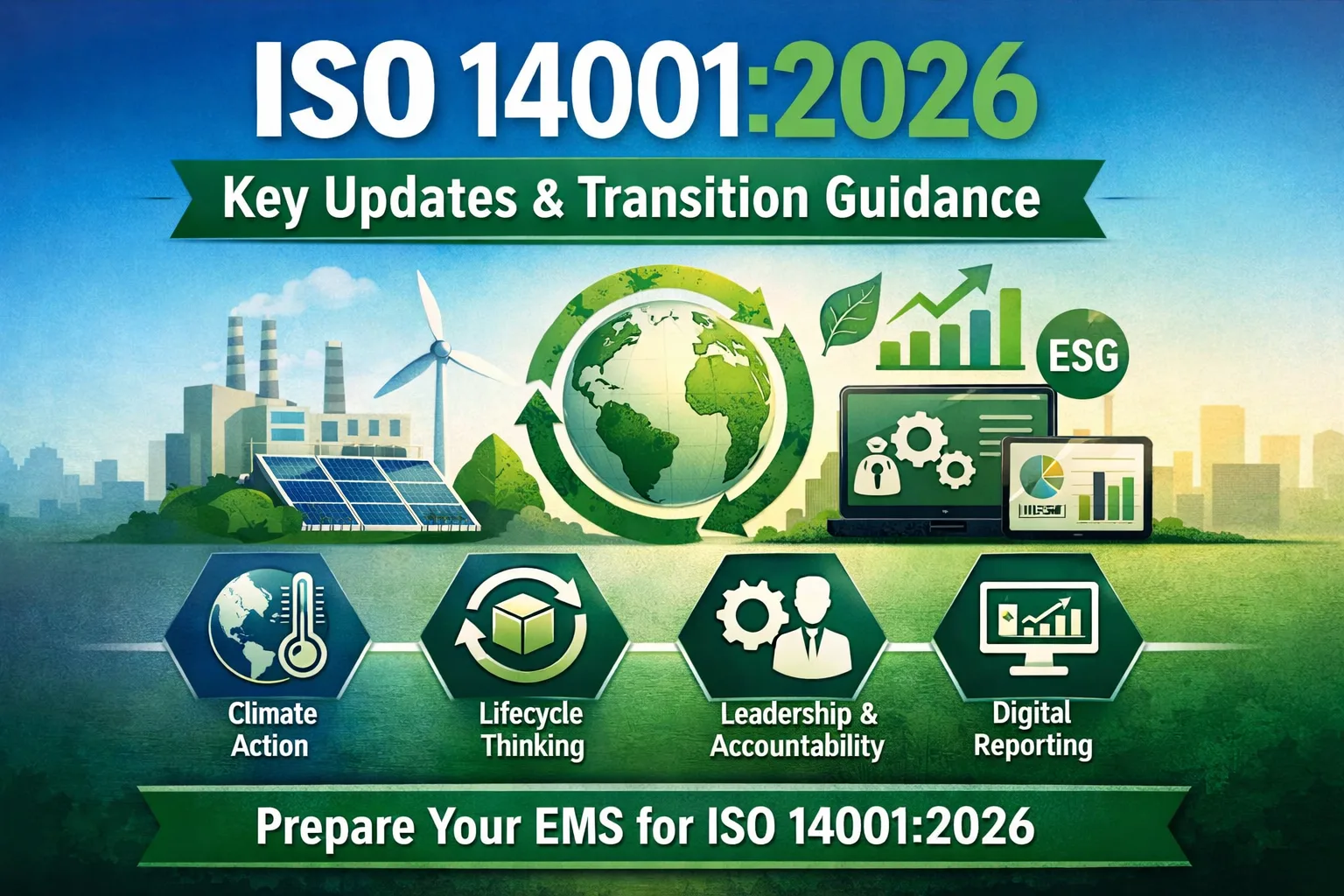
ISO 14001:2026 EMS Key Updates and Transition Guidance
Environmental management standards don’t change often—but when they do, the implications are significant for organizations that rely on them for compliance, credibility, and operational control. The upcoming revision of International Organization for Standardization ISO 14001 is one of those moments.
ISO 14001:2026 is expected to introduce targeted but meaningful updates that reflect evolving environmental risks, regulatory expectations, and stakeholder pressure. If your organization is certified—or planning to be—understanding these updates early is not optional. It’s a strategic advantage.
Understanding the Context of the 2026 Revision
The current version, ISO 14001:2015, brought a major structural shift by aligning with Annex SL and emphasizing risk-based thinking and lifecycle perspectives. However, over the past decade, environmental priorities have shifted significantly:
- Climate change has become central to corporate strategy
- ESG (Environmental, Social, Governance) expectations have intensified
- Regulators are demanding greater transparency and accountability
- Supply chain environmental impacts are under closer scrutiny
ISO 14001:2026 is being revised to reflect these realities, ensuring that Environmental Management Systems (EMS) remain relevant, actionable, and aligned with global priorities.
Transition Timeline: What to Expect
Although the official publication of ISO 14001:2026 is expected in 2026, organizations should anticipate a structured transition period.
Typical ISO transition timelines include:
- Publication Year (2026): Final standard released
- Transition Period (2–3 years): Organizations upgrade their EMS
- Deadline: Old certifications (ISO 14001:2015) become invalid
Waiting until the last year is risky. Early adopters benefit from smoother transitions and competitive positioning.
Key Updates in ISO 14001:2026
While the final draft is subject to confirmation, several anticipated changes are already shaping how organizations should prepare.
1. Stronger Focus on Climate Change
One of the most notable updates is the explicit integration of climate change considerations into the EMS framework.
Organizations will be expected to:
- Identify climate-related risks and opportunities
- Evaluate the impact of operations on climate
- Align environmental objectives with climate mitigation and adaptation strategies
This change aligns ISO 14001 with global frameworks such as the Paris Agreement and strengthens its relevance for sustainability reporting.
2. Enhanced Lifecycle Perspective
ISO 14001:2015 introduced lifecycle thinking, but implementation has often been superficial. The 2026 version is expected to tighten this requirement.
Key enhancements may include:
- More rigorous assessment of upstream and downstream impacts
- Greater accountability for suppliers and outsourced processes
- Integration of circular economy principles
Organizations will need to move beyond internal operations and demonstrate control over environmental impacts across the value chain.
3. Greater Emphasis on Leadership and Accountability
Top management involvement will be more explicitly defined and measurable.
Expected changes:
- Clearer demonstration of leadership commitment
- Stronger linkage between EMS and business strategy
- Accountability for environmental performance at executive level
This ensures that ISO 14001 is not treated as a compliance exercise but as a core business function.
4. Improved Risk and Opportunity Management
The revised standard will likely refine how organizations identify and act on environmental risks and opportunities.
Enhancements may include:
- Structured methodologies for risk assessment
- Integration with enterprise risk management (ERM) systems
- Focus on emerging risks such as biodiversity loss and resource scarcity
This will push organizations toward a more proactive environmental strategy.
5. Digitalization and Data Transparency
With increasing reliance on digital tools, ISO 14001:2026 is expected to acknowledge the role of data in environmental management.
Organizations may need to:
- Improve environmental data collection and monitoring systems
- Ensure traceability and accuracy of environmental metrics
- Support digital reporting and compliance frameworks
This aligns with the growing demand for real-time environmental performance tracking.
6. Alignment with ESG and Sustainability Reporting
ISO 14001 will likely strengthen its compatibility with ESG frameworks and sustainability disclosures.
Key implications:
- Easier integration with GRI, TCFD, and other reporting standards
- Increased expectation for public disclosure of environmental performance
- Greater scrutiny from investors and stakeholders
This transforms ISO 14001 into a tool not just for compliance—but for reputation and market positioning.
7. Engage Your Supply Chain
Suppliers will play a bigger role under the revised standard.
Actions include:
- Defining environmental criteria for suppliers
- Monitoring supplier performance
- Encouraging sustainable procurement practices
Your EMS is only as strong as your weakest supplier link.
Common Challenges During Transition
Organizations typically face several hurdles:
- Resistance to change within leadership
- Lack of expertise in climate risk assessment
- Inadequate data systems
- Limited visibility into supply chain impacts
Addressing these early prevents last-minute compliance pressure.
Strategic Benefits of Early Transition
Organizations that act early don’t just comply—they lead.
Key advantages:
- Stronger market positioning
- Improved stakeholder confidence
- Better risk management
- Alignment with global sustainability expectations
ISO 14001:2026 is not just a revision—it’s a strategic upgrade.
How Burraq Consulting Can Support You?
Transitioning to ISO 14001:2026 requires more than documentation updates. It demands a shift in thinking, systems, and leadership engagement.
Burraq Consulting supports organizations with:
- Gap analysis and transition planning
- EMS redesign aligned with ISO 14001:2026
- Climate risk integration strategies
- Internal auditor and lead auditor training
- Certification readiness support
The goal is not just certification—but building a resilient, future-ready environmental management system.
Conclusion
ISO 14001:2026 reflects a clear message: environmental management is no longer a back-office function. It is central to business sustainability, risk management, and long-term growth.
Organizations that treat this update as a strategic opportunity—not a compliance burden—will be the ones that stand out in increasingly competitive and regulated markets.
If you start preparing now, the transition won’t feel like a disruption. It will feel like progress.