
NVQ Level 6 vs Othm Level 6: Key Differences
- Burraq Consulting
- HSE, ProQual
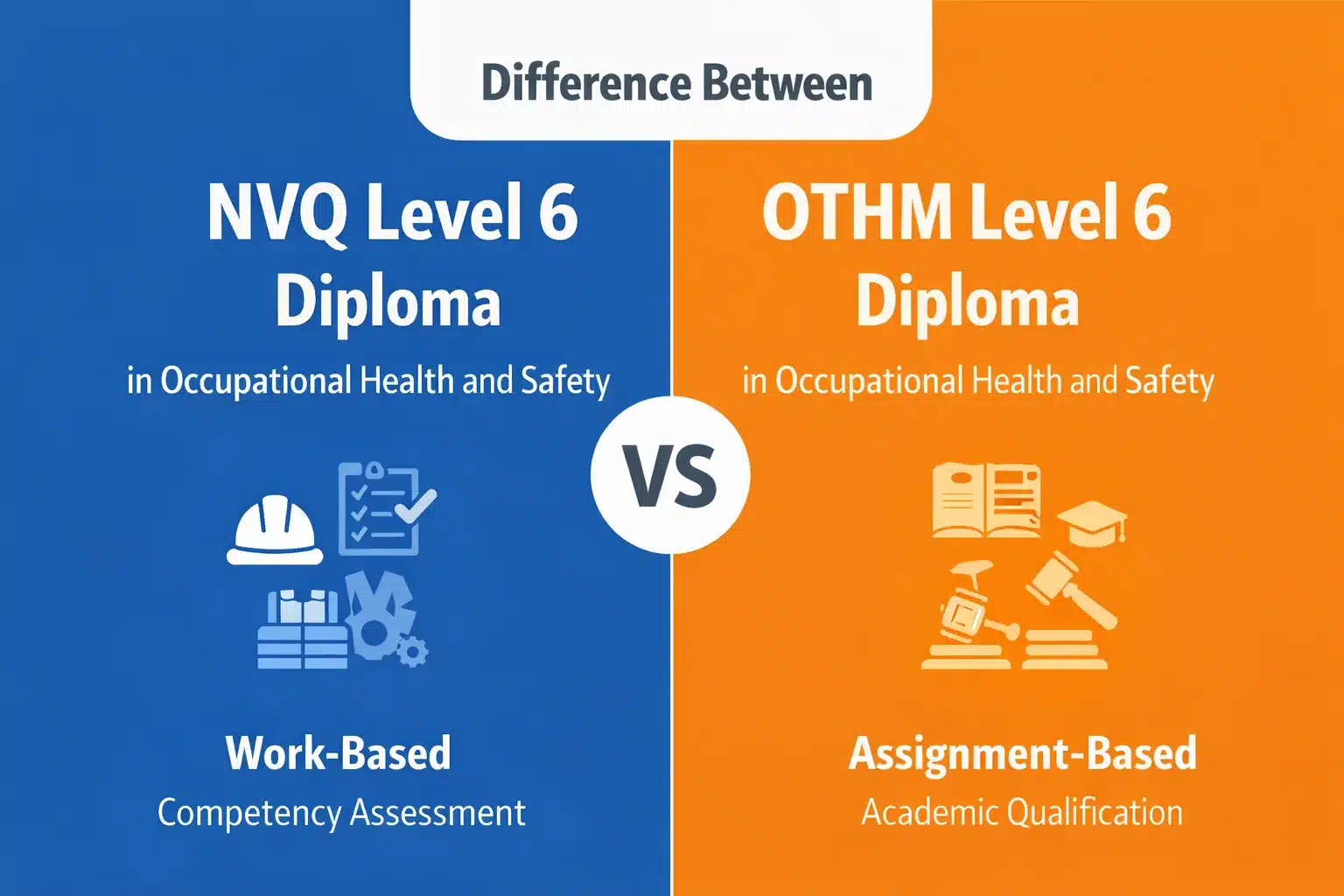
Understand the Differences: NVQ Level 6 vs. OTHM Level 6 in Health and Safety
Selecting the right Level 6 qualification is the biggest challenge for health and safety practitioners who want to achieve Graduate (GradIOSH) or Chartered (CMIOSH) status. The NVQ Level 6 Diploma in Occupational Health and Safety Practice and the OTHM Level 6 Diploma in Occupational Health and Safety are both positioned at the same level on the Regulated Qualifications Framework (RQF). However, they differ significantly in how they are delivered, assessed, and how well they fit your everyday work.
1. NVQ Level 6 Diploma: The "Evidence-Based" Route
The NVQ (National Vocational Qualification) is a qualification based on your skills. It focuses on showing that you are already working at a senior level in your job, not just learning theories from books.
Core Assessment Style
There are no exams or simulated assignments. Instead, you create a portfolio of evidence. You use your actual work documents, such as risk assessments you’ve written, minutes from safety meetings you’ve led, and training sessions you’ve conducted. You relate these documents to the qualification units.
Key Features
Work-Based: You need to be employed in a health and safety role to complete this. You cannot create fake evidence.
Assessor-Led: An assessor reviews your documents. They may also observe your work or have a professional discussion to confirm your skills.
Flexibility: There are no set deadlines for specific units. You can progress at your own pace, often finishing in 6 to 12 months, depending on how quickly you gather your evidence.
Why choose it?
If you have years of experience but lack the official documentation to prove it, the NVQ is the best option. It confirms your real-world skills without requiring you to memorize academic references.
The Technical Breakdown (10 Mandatory Units)
To pass the NVQ, you must provide specific evidence for 10 units. You don’t write essays; you upload your actual work files.
- Unit 1: Health & Safety Culture – Evidence of how you’ve improved safety behavior in your team.
- Unit 2: H&S Policy – You must show a policy you developed or significantly updated.
- Unit 3: Communication Systems – Evidence of safety briefings, newsletters, or digital reporting tools you’ve implemented.
- Unit 4: Individual & Organisational Competence – Training matrices and records of staff training you’ve overseen.
- Unit 5: Risk Control – Actual risk assessments and COSHH reports from your site.
- Units 6 & 7: Proactive & Reactive Monitoring – Your audit schedules (proactive) and your accident investigation reports (reactive).
- Unit 8: Emergency Response – Fire drill logs and emergency evacuation plans you authored.
- Unit 9: H&S Review Systems – Minutes from management review meetings you chaired.
- Unit 10: Professional Development – Your own CPD logs and reflective accounts.
The Practical Reality
- Assessment: A portfolio-based “Show Me” approach. An assessor interviews you and checks your documents.
- Best For: The “Site Warrior.” If you are a busy Safety Manager on a construction site or in a factory, the NVQ is great because your work is your homework.
- The “Wall”: If you are currently unemployed or in a junior role, you cannot do this. You won’t have the “evidence” required to pass.
Pricing Factors
Average Cost: $1,500 – $2,300 but at Burraq Consulting we are offering NVQ level 6 diploma in $890 USD only.
2. OTHM Level 6 Diploma in Occupational Health and Safety
The OTHM Level 6 is a regulated vocational qualification. Its structure is more similar to a university degree. It explores the reasons behind health and safety management. This requires a thorough understanding of legal frameworks and management models.
Core Assessment Type
The assessment type is through written assignments. You are required to write a comprehensive report or essay on a given topic. While you can use your own workplace as a case study, you are largely assessed on your capacity to analyze information and meet certain academic criteria.
Key Points
- Knowledge-Based: It consists of 7 to 8 units, including Health and Safety Management Principles, Risk Management, and Occupational Health.
- No Mandatory Workplace: While it is useful, you do not necessarily have to be working in a high-level safety position to pass, as long as you have the capacity to complete the research-intensive assignments.
- Pathway to Master’s: As it is assignment-intensive, it is highly regarded by universities for those seeking to “top-up” to an MSc in Occupational Health and Safety.
Why choose this pathway?
If you are interested in structured learning, research, and writing, or if you are seeking to transition into a more senior management or consultancy position where academic rigor is valued, then OTHM is a good option.
The Technical Breakdown (7 Mandatory Units)
Each of these units requires a 2,500 to 4,000-word written assignment/report.
- Unit 1: Health and Safety Management Principles and Policy – Analyzing global management models (like ISO 45001) and their strategic application.
- Unit 2: Health and Safety Management Practice – How to integrate safety into wider business operations.
- Unit 3: Risk and Incident Management – Deep dive into root cause analysis theories (e.g., Swiss Cheese Model, BowTie).
- Unit 4: Promoting a Positive H&S Culture – Psychology of safety and human error.
- Unit 5: Maintaining a Safe Workplace Environment – Technical unit on physical hazards (noise, vibration, electricity).
- Unit 6: H&S Law, Regulation and Influence – Understanding the legal hierarchy, tort law, and international frameworks (ILO).
- Unit 7: Development of the H&S Practitioner – Planning your career and ethical leadership.
The Practical Reality
- Assessment: “Tell Me” approach. You research a topic, cite your sources (Harvard referencing), and submit a professional report.
- Best For: The “Strategic Thinker.” If you want to move into consultancy, corporate roles, or eventually get a Master’s degree (MSc), OTHM is a perfect bridge.
- The “Wall”: If you hate writing and haven’t written an essay since school, the OTHM will feel like a slog. It requires heavy desk time.
Pricing Factors
Average Cost: $1,200 – $1,900
Direct Comparison: Which one fits you?
| Criteria | NVQ Level 6 | OTHM Level 6 |
| Main Goal | Prove current competence | Gain new management knowledge |
| Assessment | Portfolio of work files | Written assignments/Research |
| Entry Requirements | Must be in a safety job | Level 3/5 or relevant experience |
| Duration | Self-paced (Average 6–10 months) | Structured (6 or 9 months) |
| IOSH Status | Leads to CertIOSH (then CMIOSH) | Leads to CertIOSH (then CMIOSH) |
| Academic Weight | 100% (Bachelor’s equivalent) | 100% (Bachelor’s equivalent) |
| Price | $890 | $1,200 – $1,900 |
The Verdict: Which one actually wins?
Choose NVQ Level 6 if:
You want the path of least resistance: You already have a mountain of paperwork on your laptop from your current job.
You need CMIOSH fast: For experienced managers, the NVQ is often the quickest route to membership because there’s no “learning curve”—just a “document gathering” phase.
You work in Construction/Oil & Gas: These sectors highly value the “Competent Person” status that an NVQ implies.
Choose NVQ Level 6 if:
You want a Degree Top-Up: Most UK universities will accept the OTHM Level 6 for direct entry into the final stage of an MSc. NVQs are harder to map for academic credits.
You are between jobs: You can complete the OTHM using case studies and research without needing a current “live” workplace.
You want to be a Consultant: The academic rigor helps you learn how to write the high-level reports that corporate clients expect.