
OSHA General Industry vs OSHA Construction Industry: Key Differences
Workplace safety is no longer just a regulatory requirement—it is a business imperative. Organizations that invest in occupational health and safety not only protect their workforce but also reduce incidents, improve productivity, and strengthen their reputation. When it comes to OSHA compliance, however, many employers struggle with one critical question:
What is the difference between OSHA General Industry and OSHA Construction Industry standards?
This confusion is common, especially in regions like Pakistan where international safety frameworks such as OSHA are widely adopted as best practices across manufacturing, oil & gas, infrastructure, utilities, and construction sectors. Understanding the distinction between these two OSHA standards is essential for selecting the right training, implementing correct controls, and staying compliant.
In this detailed guide, Burraq Consulting breaks down the differences in a clear, practical, and easy-to-understand manner—so you can make informed safety decisions with confidence.
Understanding OSHA: A Quick Overview
OSHA stands for the Occupational Safety and Health Administration, a regulatory body under the U.S. Department of Labor. While OSHA regulations are legally enforced in the United States, they are globally recognized as gold-standard safety benchmarks. Many organizations in Pakistan adopt OSHA frameworks voluntarily to meet international client requirements, improve safety culture, and align with ISO and global HSE expectations.
OSHA regulations are divided into multiple parts, but the two most commonly applied standards are:
OSHA General Industry (29 CFR 1910)
OSHA Construction Industry (29 CFR 1926)
Although both aim to prevent workplace injuries, illnesses, and fatalities, they apply to very different work environments.
What Is OSHA General Industry?
OSHA General Industry standards apply to fixed workplaces where operations are relatively stable and ongoing. These environments typically have permanent structures, consistent processes, and long-term employees working at the same location.
Industries covered under OSHA General Industry include manufacturing plants, warehouses, power generation facilities, chemical plants, refineries, logistics centers, and service industries.
The focus of General Industry standards is on routine operations, equipment safety, machine guarding, hazardous materials, ergonomics, electrical systems, and employee health programs.
Unlike construction sites, these workplaces do not constantly change. However, the risks—such as chemical exposure, machinery hazards, confined spaces, and electrical dangers—can be just as severe if not properly managed.
What Is OSHA Construction Industry?
OSHA Construction standards apply specifically to construction activities, where work conditions are temporary, dynamic, and often high-risk. Construction sites are constantly evolving, with changing layouts, multiple contractors, heavy equipment, and work at heights.
This standard covers activities such as building construction, demolition, excavation, road works, scaffolding, steel erection, and large infrastructure projects.
Construction safety focuses heavily on fall protection, scaffolding, excavation safety, cranes, ladders, and personal protective equipment (PPE). Because construction sites are inherently hazardous and unpredictable, OSHA construction standards are more task-specific and enforcement-oriented.
Core Difference Between OSHA General Industry and Construction
The primary distinction lies in the nature of the work environment.
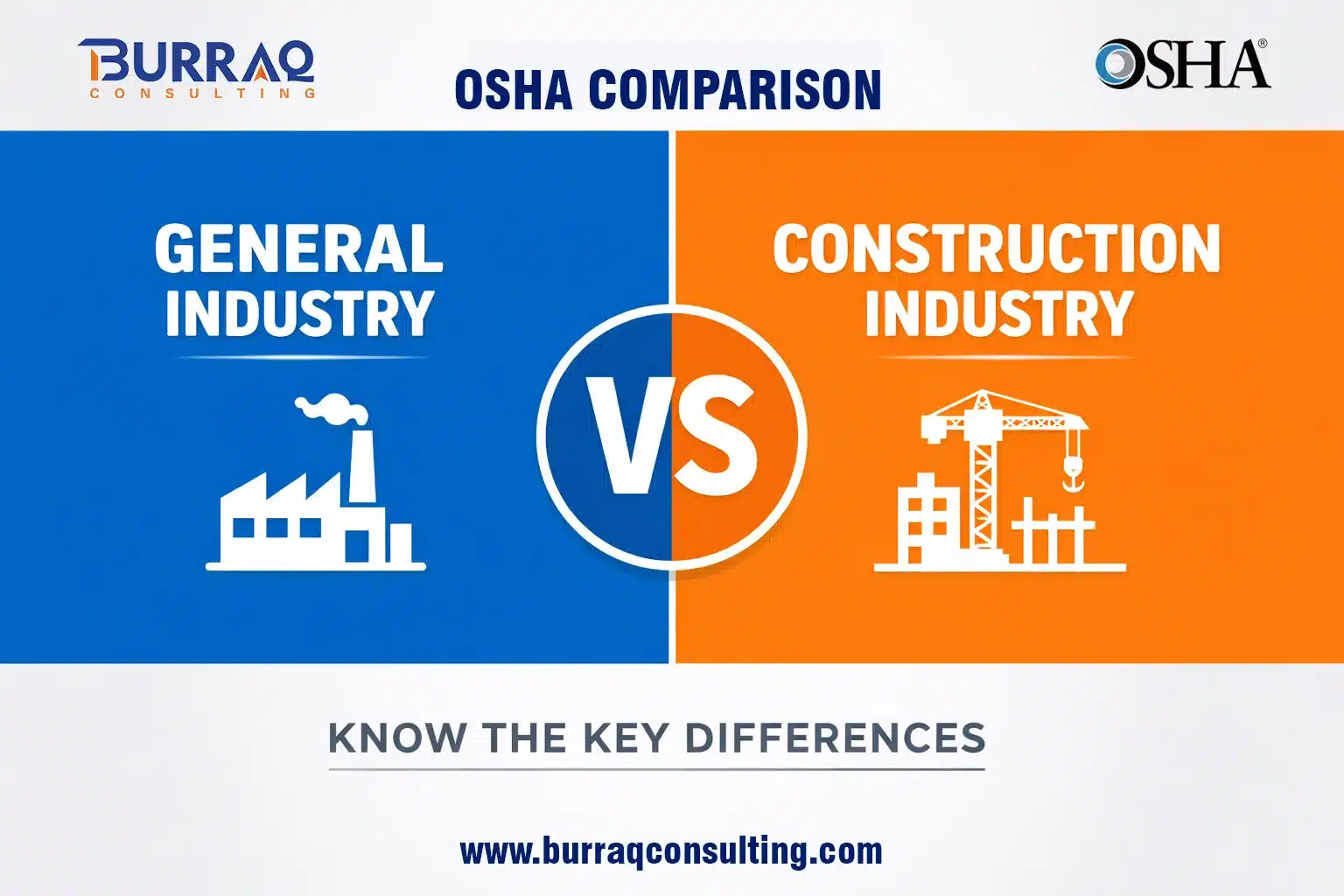
OSHA General Industry applies to ongoing operations in permanent facilities, while OSHA Construction applies to temporary worksites involved in building, altering, or repairing structures.
Many employers mistakenly assume one standard fits all. In reality, applying the wrong OSHA framework can leave serious safety gaps—and expose organizations to accidents, legal liabilities, and reputational damage.
Key Differences Explained in Detail
1. Type of Workplace
General Industry environments are stable and controlled. Workers usually perform the same tasks daily using fixed machinery and established procedures.
Construction workplaces are temporary and continuously changing. Hazards evolve as the project progresses—from excavation risks at the start to fall hazards and structural risks during later phases.
This difference alone significantly impacts how safety controls are designed and implemented.
2. Nature of Hazards
In General Industry, hazards are often process-related. These include mechanical hazards from machines, exposure to chemicals, electrical risks, noise, heat stress, and ergonomic issues due to repetitive work.
In Construction, hazards are more task-based and physical. Falls from height, trench collapses, struck-by incidents, crane accidents, and electrical contact are among the leading causes of fatalities.
OSHA construction standards are therefore more prescriptive in addressing immediate life-threatening risks.
3. Fall Protection Requirements
Fall protection is one of the most noticeable differences.
In General Industry, fall protection is typically required at 4 feet or more, especially around platforms, walkways, and mezzanines.
In Construction, fall protection requirements usually apply at 6 feet or more, and specific rules exist for scaffolding, roofing, steel erection, and ladder use.
Construction standards are far more detailed due to the high fatality rate associated with falls in construction activities.
4. Training and Competency Expectations
OSHA General Industry emphasizes process safety training, such as lockout/tagout, hazard communication (HAZCOM), confined space entry, and machine operation.
OSHA Construction training focuses more on task-specific competencies, including working at height, scaffolding safety, excavation safety, rigging, and crane signaling.
Both require training, but the content, frequency, and focus differ significantly.
5. Equipment and Tools
General Industry primarily uses fixed machinery and production equipment that requires guarding, maintenance, and procedural controls.
Construction relies heavily on portable tools, heavy equipment, cranes, and scaffolding, which introduce mobility-related risks and require constant inspection.
This difference affects inspection regimes, permits, and supervision requirements.
6. Regulatory Structure
OSHA General Industry standards are broader and sometimes less detailed, allowing employers flexibility in implementing controls based on risk assessments.
OSHA Construction standards are more specific and rule-driven, with explicit requirements for many construction tasks. This reflects the high-risk nature of construction work.
Can Both Standards Apply to One Organization?
Yes—and this is where many organizations get confused.
A company may fall under both OSHA General Industry and Construction standards depending on the type of work being performed. For example:
A manufacturing plant undergoing expansion may require Construction standards during the building phase and General Industry standards once operations begin.
Maintenance activities may fall under General Industry, while major structural modifications fall under Construction.
Understanding when each standard applies is critical for compliance and effective risk management.
OSHA Training: Choosing the Right Course
Selecting the correct OSHA training depends entirely on your industry and job role.
- If your organization operates in manufacturing, warehousing, utilities, or services, OSHA General Industry training is the right fit.
- If your work involves construction, civil works, scaffolding, excavation, or infrastructure projects, OSHA Construction Industry training is essential.
Burraq Consulting provides professionally delivered OSHA training programs designed to match real-world industry needs, not just theory.
Why Choose Burraq Consulting for OSHA Training and Certification?
At Burraq Consulting, we do more than deliver courses—we help organizations build sustainable safety systems.
Our OSHA programs are designed by experienced HSE professionals who understand both international standards and local industry challenges. We ensure that participants not only pass assessments but also apply OSHA principles practically at their workplaces.
Whether you need OSHA General Industry, OSHA Construction Industry, or guidance on which standard applies to your operations, our experts provide clear direction, customized solutions, and ongoing support.
Final Thoughts
OSHA General Industry and OSHA Construction Industry standards serve the same purpose—protecting lives—but they operate in very different environments. Understanding their differences is essential for compliance, training selection, and effective hazard control.
If your organization is serious about safety excellence, choosing the right OSHA framework is the first step toward a safer, more productive workplace.
For professional OSHA training, consultancy, and tailored HSE solutions in Pakistan, Burraq Consulting is your trusted partner.