
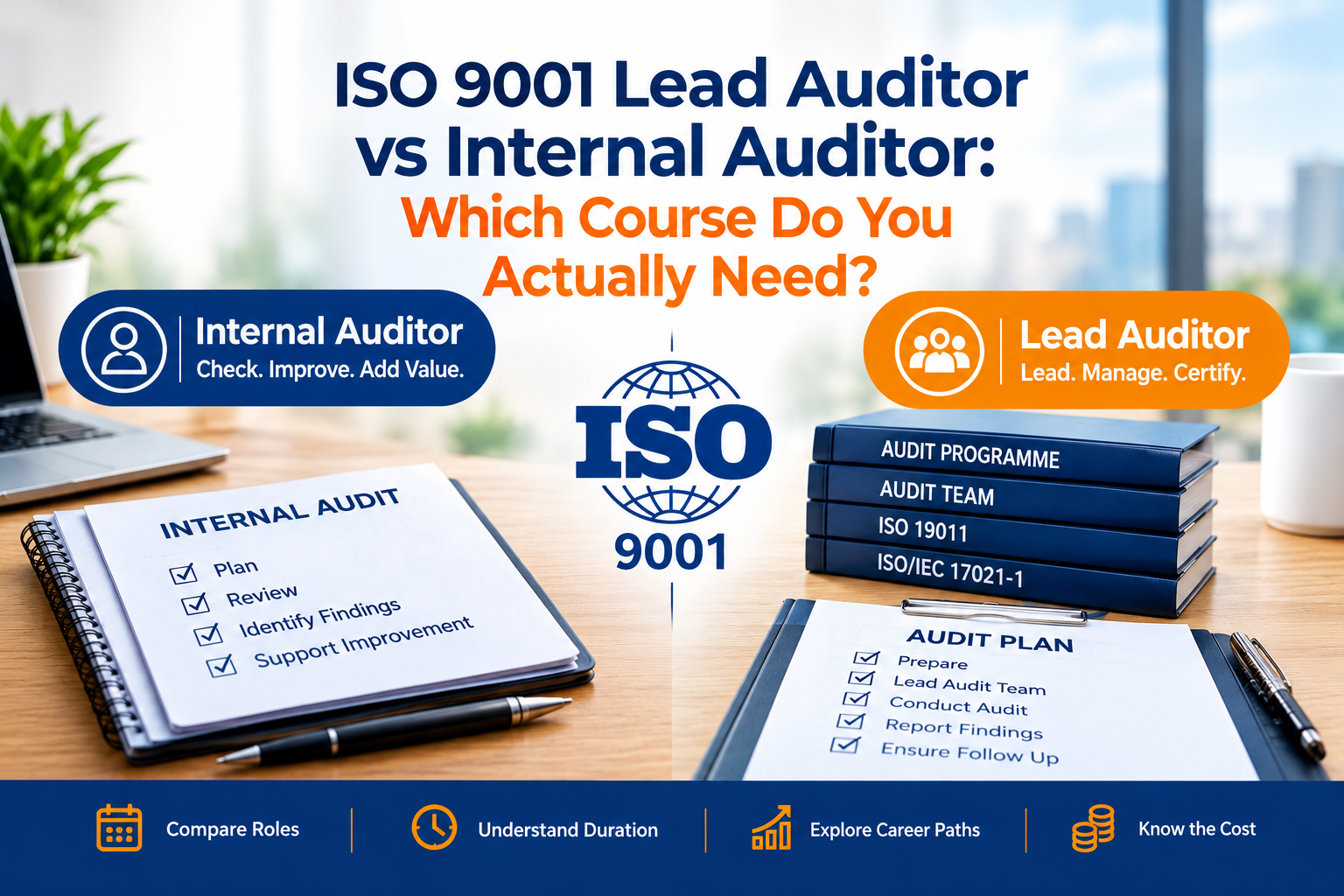
ISO 9001 Lead Auditor vs Internal Auditor Which Course Do You Actually Need?
Every month we get the same phone call. Someone from a quality department, or an engineer who has just been told to “handle the ISO side,” asks us which ISO 9001 course they should book. They have seen two options on our website, the Internal Auditor course and the Lead Auditor course, and they cannot tell why one takes five days and the other takes two.
It is a fair question. Both courses teach you how to audit a quality management system. Both use the same standard. But they are built for very different jobs, and picking the wrong one usually means either paying for training you will never use or finding out later that your certificate does not open the door you wanted.
This guide explains the difference in plain terms, so you can choose the course that matches where you are now and where you want to be in two or three years.
What Does an ISO 9001 Internal Auditor Do?
An internal auditor checks their own organization’s quality management system (QMS). This is called a first-party audit. ISO 9001 requires every certified company to run internal audits at planned intervals, so someone inside the business has to do them.
In practice, internal auditors walk into a department, pick a process such as purchasing, production or customer complaints, and check whether people are doing what the procedures say. They also check whether those procedures actually meet the standard. Then they write up findings so management can fix problems before the external certification body finds them.
Most internal auditors are not full-time auditors. They are quality officers, supervisors, engineers or HSE staff who audit a few days a year alongside their normal job.
What the Internal Auditor course covers
The ISO 9001 Internal Auditor course usually runs for 3 days. It typically covers:
- The clauses of ISO 9001 and what each one asks for
- How to plan an internal audit and build a checklist
- Interviewing staff and collecting objective evidence
- Writing nonconformities that are clear and fair
- Following up on corrective actions
The focus is practical. By the end, you should be able to audit a process in your own company with confidence.
What Does an ISO 9001 Lead Auditor Do?
A lead auditor plans, manages, and leads a full audit, often with a team of auditors working under them. The role exists across all three audit types, but it matters most in second-party audits (a company auditing its suppliers) and third-party audits (a certification body deciding whether to issue or renew an ISO 9001 certificate).
The lead auditor holds the opening meeting with top management, assigns areas to team members, determines the severity of each finding, and presents the final recommendation. If you have ever seen a certification audit, the person running the closing meeting is the lead auditor.
What the Lead Auditor course covers
The ISO 9001 Lead Auditor course is usually a 6-day program of around 40 hours, ending with a formal written exam. The most recognized versions are certified by CQI and IRCA. Along with everything in the internal auditor course, it adds:
- The audit principles and guidance in ISO 19011 and the certification rules in ISO/IEC 17021-1
- Managing an audit team and an audit programme
- Stage 1 and Stage 2 certification audits
- Grading findings as major or minor nonconformities
- Leading opening and closing meetings with senior management
- Making certification recommendations
The exam is the part people underestimate. You need to know the standard well and apply it to case studies, not just repeat definitions.
Lead Auditor vs Internal Auditor: Side-by-Side Comparison
| ISO 9001 Internal Auditor | ISO 9001 Lead Auditor | |
|---|---|---|
| Typical duration | 3 days | 6 days (about 40 hours) |
| Audit types | First-party (your own company) | First, second and third-party |
| Leads an audit team | No | Yes |
| Exam | Short assessment, varies by provider | Formal written exam |
| Best for | Quality staff, supervisors, department heads | QA managers, consultants, supplier auditors, aspiring certification body auditors |
| Can work for a certification body | No | Yes, with audit experience and registration |
| Cost | Lower | Higher |
| Prior knowledge | Helpful but not required | Good working knowledge of ISO 9001 recommended |
Which Course Fits Your Role?
Forget the titles for a moment and think about what you will actually be doing at work. Here are the situations we see most often.
Choose the Internal Auditor course if:
- Your company is preparing for ISO 9001 certification and needs a few trained people to run internal audits
- You are a supervisor or engineer who audits other departments a few times a year
- You are new to ISO 9001 and want a solid, affordable starting point
- Your manager needs you trained quickly and five days away from site is not realistic
Choose the Lead Auditor course if:
- You manage the QMS or report to top management on quality
- You audit suppliers or subcontractors, which is common in oil and gas, construction and manufacturing across the Gulf
- You want to work as a freelance auditor or join a certification body
- You are a consultant who helps clients get certified
- You want a qualification that carries weight on your CV for QA/QC manager roles
One honest point: if you only ever plan to audit inside your own company, the lead auditor course is not wasted, but it is more than you need. Plenty of quality professionals start with the internal course, use it for a year or two, and move up to lead auditor once their job starts to include supplier audits or managing the whole QMS. There is nothing wrong with that order.
Career Value in Saudi Arabia and the Gulf
Across KSA, the UAE, Qatar, Kuwait and Oman, ISO 9001 is close to a basic requirement for companies bidding on government projects and large oil, gas and infrastructure contracts. Main contractors expect their suppliers to be certified, and they send their own people to audit them. That creates steady demand for qualified auditors.
For job seekers, the difference shows up in job ads. QA/QC manager, quality manager and supplier quality engineer roles regularly list a lead auditor certificate as required or preferred. Internal auditor certificates show up more often in officer and coordinator roles.
A note on ISO 9001:2026
Timing matters right now. The new edition, ISO 9001:2026, was scheduled for publication on 16 September 2026, which starts a transition period for certified companies. Based on past revisions, that period is expected to run about three years, though accreditation bodies set the final dates.
The core of the standard stays the same: the process approach, Plan-Do-Check-Act and risk-based thinking. The changes put more weight on quality culture, ethical behaviour and change management. Every certified company will need auditors who understand the new requirements, so if you are booking training now, make sure the course covers the 2026 edition.
Can You Start With Internal Auditor and Upgrade Later?
Yes, and for many people it is the smarter route. The internal course gives you a working knowledge of the ISO 9001 clauses and real audit practice inside your own company. When you later sit the lead auditor course, you walk in already comfortable with the standard, which makes the 5 days easier and the exam far less stressful.
The trade-off is total cost and time. Taking both courses costs more than going straight to lead auditor. So if you already know you want to audit suppliers or work for a certification body, skip the step and book the lead auditor course directly.
A simple rule we give our delegates: if your next job is about your own company, start internal. If your next job is about other companies, go lead.
Frequently Asked Questions (FAQs)
No. Most lead auditor courses have no formal prerequisite. A good working knowledge of ISO 9001 helps, though, because the course moves fast and the exam tests how you apply the clauses.
Not on its own. Certification bodies look for lead auditor training, along with audit experience and relevant work history.
A CQI and IRCA certified lead auditor course is recognized internationally, including across the GCC. Always check that the course you book carries that certification.
If you trained on ISO 9001:2015, your certificate does not expire, but you will need to understand the new requirements to audit against them. A short transition or update course is usually enough.
Yes. Both courses are commonly offered as live virtual classes as well as in a classroom, so you can train without leaving site for a week.
The Bottom Line
The internal auditor course trains you to check your own company’s quality system. The lead auditor course trains you to run full audits of any organization, lead a team, and work toward certification body roles. One is not better than the other. They answer different questions about your job.
If you are still unsure, look at the next role you want and read three or four job ads for it. The certificate they ask for is usually the answer.
At Burraq Consulting, we run both the ISO 9001 Internal Auditor and ISO 9001 Lead Auditor courses in classroom and live online formats for delegates across Saudi Arabia, the UAE, Qatar, Kuwait and Oman. Talk to our training team and we will help you pick the right course for your role, with no pressure to book the more expensive one.