
ISO 14001:2015 vs ISO 14001:2026
The transition from ISO 14001:2015 to ISO 14001:2026 is expected to introduce updates that reflect current environmental challenges, climate-related obligations, ESG expectations, digital transformation, and stronger stakeholder accountability. While the core framework of the Environmental Management System (EMS) will likely remain aligned with Annex SL structure, organizations should expect refinements in terminology, compliance expectations, risk management, and sustainability integration.
Since the 2026 edition is still under development/revision discussions, the final published requirements may vary. However, the following comparison reflects the anticipated direction based on ISO committee discussions and evolving industry practices.
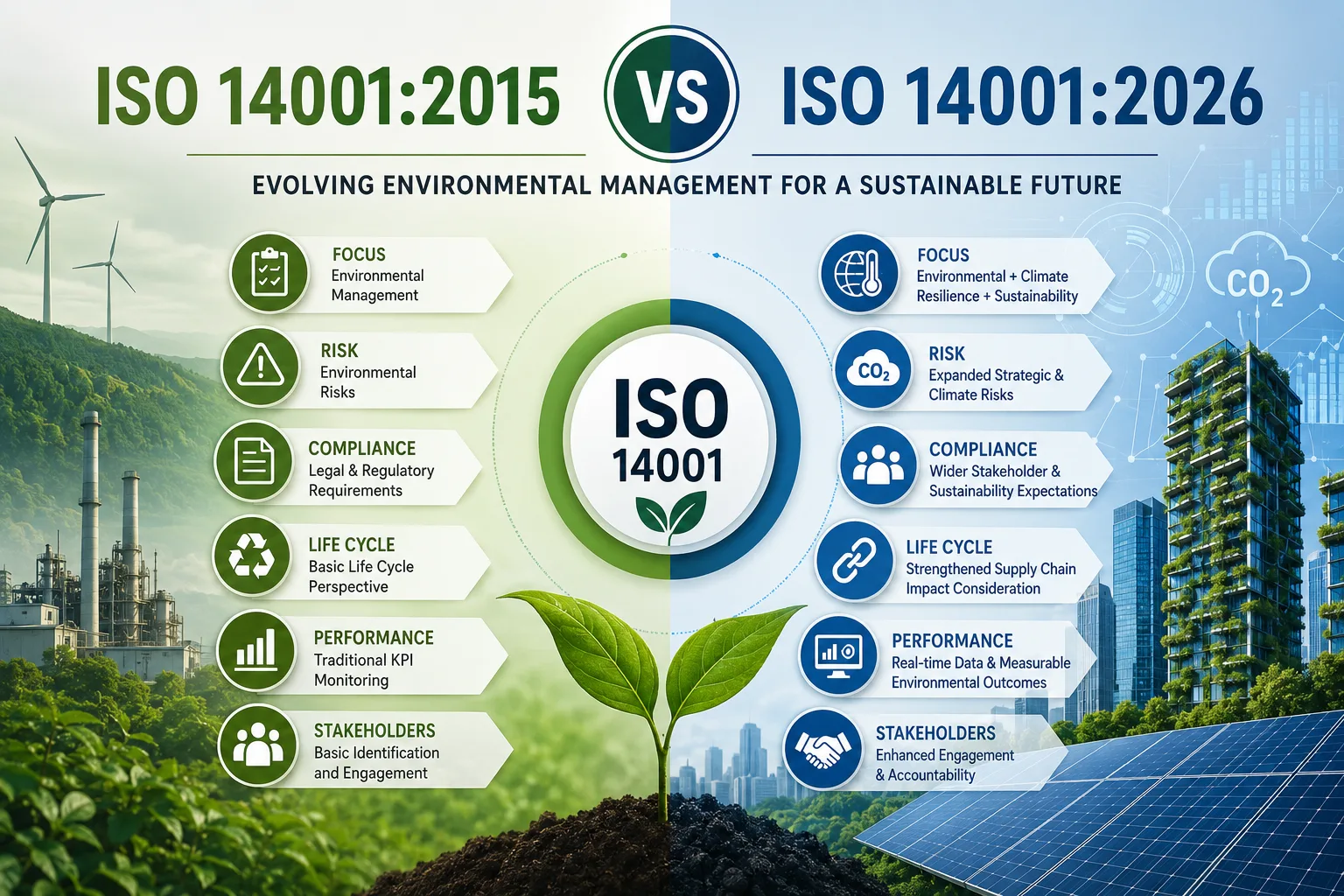
Quick Comparison Table
| Area | ISO 14001:2015 | ISO 14001:2026 |
|---|---|---|
| Focus | Environmental management | Environmental + climate resilience + sustainability alignment |
| Climate Change | Limited indirect consideration | Stronger climate-related obligations |
| ESG Integration | Minimal | Greater alignment with ESG reporting |
| Risk-Based Thinking | Environmental risks/opportunities | Expanded strategic and climate risks |
| Compliance Obligations | Legal and regulatory focus | Wider stakeholder and sustainability expectations |
| Life Cycle Perspective | Basic requirement | More detailed supply chain/environmental impact consideration |
| Digitalization | Not addressed | Possible integration of digital monitoring and data management |
| Interested Parties | Basic identification | Enhanced stakeholder engagement expectations |
| Performance Evaluation | Traditional KPI monitoring | Real-time data, measurable environmental outcomes |
| Supply Chain Control | Limited operational control | Stronger supplier environmental accountability |
| Emergency Preparedness | Environmental incidents | Climate resilience and environmental emergency readiness |
| Documentation | Conventional documented information | More flexibility with digital systems and analytics |
What ISO 14001:2015 Focused On
Core Objective
ISO 14001:2015 was developed to help organizations establish a systematic Environmental Management System (EMS) that improves environmental performance, ensures legal compliance, and reduces environmental impacts.
The standard introduced:
- Risk-based thinking
- Life cycle perspective
- Leadership involvement
- Strategic integration with business processes
- Continuous improvement
Key Clauses in ISO 14001:2015
- Context of the organization
- Leadership and commitment
- Environmental policy
- Planning and risk management
- Operational control
- Performance evaluation
- Improvement and corrective actions
The 2015 revision significantly modernized environmental management by aligning EMS with organizational strategy rather than treating it as a standalone compliance activity.
Why ISO 14001 Is Being Updated
Environmental expectations have changed dramatically since 2015. Organizations now face pressure from:
- Climate change regulations
- Carbon reduction commitments
- ESG reporting requirements
- Supply chain sustainability demands
- Investor expectations
- Green procurement standards
- Environmental transparency requirements
The revised ISO 14001:2026 is expected to address these evolving global expectations.
Major Expected Changes in ISO 14001:2026
1. Stronger Climate Change Requirements
One of the biggest expected changes is the integration of climate-related risks into EMS planning.
Organizations may need to evaluate:
- Climate-related operational risks
- Carbon footprint impacts
- Energy transition strategies
- Physical climate risks
- Environmental resilience planning
This aligns with broader ISO amendments already introduced across management system standards regarding climate change considerations.
2. Enhanced ESG Alignment
Modern organizations are increasingly measured through Environmental, Social, and Governance (ESG) performance.
ISO 14001:2026 may include stronger alignment with:
- Sustainability reporting
- Environmental disclosures
- Carbon accountability
- Sustainable procurement
- Investor-driven environmental metrics
This could make EMS more relevant for multinational corporations, exporters, and publicly accountable organizations.
3. Expanded Supply Chain Environmental Control
ISO 14001:2015 introduced the concept of life cycle perspective, but implementation often remained limited.
The 2026 version is expected to strengthen:
- Supplier environmental evaluation
- Outsourced process control
- Sustainable sourcing
- Waste reduction across supply chains
- Vendor environmental performance monitoring
Organizations may need more evidence of environmental oversight beyond their own facilities.
4. Better Integration With Digital Systems
Environmental management is becoming increasingly data-driven.
Expected additions may encourage:
- Digital EMS platforms
- Automated environmental monitoring
- Real-time compliance tracking
- Data analytics for environmental KPIs
- Electronic environmental records
This would support smarter environmental decision-making.
5. Greater Emphasis on Measurable Environmental Performance
Organizations may be expected to demonstrate actual environmental outcomes rather than simply maintaining documented procedures.
Focus areas may include:
- Emission reduction
- Resource efficiency
- Waste minimization
- Water conservation
- Energy performance improvements
This could shift EMS audits toward evidence-based environmental effectiveness.
Similarities Between ISO 14001:2015 and ISO 14001:2026
Despite expected updates, the core structure will likely remain unchanged.
Both versions are expected to maintain:
- Plan-Do-Check-Act (PDCA) model
- Risk-based thinking
- Continuous improvement
- Legal compliance obligations
- Leadership commitment
- Internal audits
- Management reviews
- Corrective actions
Organizations already certified to ISO 14001:2015 will likely transition more smoothly than first-time implementers.
Impact on Certified Organizations
Organizations currently certified to ISO 14001:2015 should expect:
Possible Transition Audit
Certification bodies will likely provide a transition period after publication of ISO 14001:2026.
Companies may need to:
- Conduct gap assessments
- Update EMS documentation
- Revise environmental objectives
- Train internal auditors
- Update risk registers
- Address climate-related risks
Benefits of Transitioning to ISO 14001:2026
Expected benefits include:
- Improved environmental credibility
- Better ESG positioning
- Stronger regulatory preparedness
- Enhanced customer confidence
- Better environmental risk management
- Increased operational efficiency
- Improved sustainability reporting capability
- Competitive advantage in global markets
Final Thoughts
ISO 14001:2026 is expected to modernize environmental management by integrating climate awareness, sustainability expectations, ESG alignment, and stronger performance accountability into the EMS framework.
While ISO 14001:2015 established a strong foundation for environmental management, the upcoming revision is likely to push organizations toward a more strategic, data-driven, and sustainability-focused approach.
Businesses that proactively strengthen their environmental systems today will be better positioned for certification transition, regulatory compliance, and long-term market competitiveness tomorrow.
Frequently Asked Questions (FAQs)
ISO 14001:2015 focuses on establishing an Environmental Management System (EMS) for managing environmental responsibilities systematically. ISO 14001:2026 is expected to introduce stronger emphasis on climate change, ESG alignment, sustainability reporting, supply chain accountability, and measurable environmental performance.
As of now, ISO 14001:2026 is still under revision and development discussions. Final requirements may change before official publication by the International Organization for Standardization.
Yes. Organizations certified to ISO 14001:2015 will usually receive a transition period after the new version is officially published. During this time, companies can upgrade their Environmental Management System to meet the revised requirements.
The revision is expected to address modern environmental challenges such as:
- Climate change
- Carbon emissions
- ESG requirements
- Sustainability expectations
- Supply chain environmental impacts
- Digital environmental monitoring
The update aims to make environmental management more practical and aligned with global sustainability goals.
Some expected changes include:
- Stronger climate risk management
- Enhanced stakeholder engagement
- ESG integration
- Improved environmental performance tracking
- Increased supply chain accountability
- Greater focus on measurable environmental outcomes
- Better digital data integration
The core High-Level Structure (HLS) based on Annex SL is expected to remain the same. Major clauses like leadership, planning, support, operation, performance evaluation, and improvement will likely continue.
Climate change is expected to become a much stronger requirement in ISO 14001:2026. Organizations may need to identify climate-related environmental risks, resilience strategies, and sustainability impacts more comprehensively.
No. Organizations should continue implementing ISO 14001:2015 because it remains internationally recognized and valid. Companies already certified will generally find the transition to the newer version easier.
Audits may become more evidence-based and performance-focused. Certification bodies may place stronger emphasis on environmental results, climate considerations, and risk management effectiveness rather than documentation alone.
Expected benefits include:
- Improved sustainability credibility
- Better regulatory readiness
- Enhanced ESG positioning
- Stronger customer trust
- Better environmental risk management
- Improved operational efficiency
- Increased global market competitiveness
The revised standard is expected to encourage greater use of digital systems for:
- Environmental data tracking
- Compliance monitoring
- KPI measurement
- Reporting and analytics
- Real-time environmental performance evaluation
Core EMS principles are expected to remain consistent, including:
- Continuous improvement
- PDCA cycle
- Risk-based thinking
- Legal compliance
- Leadership commitment
- Internal audits
- Corrective actions
- Environmental objectives