
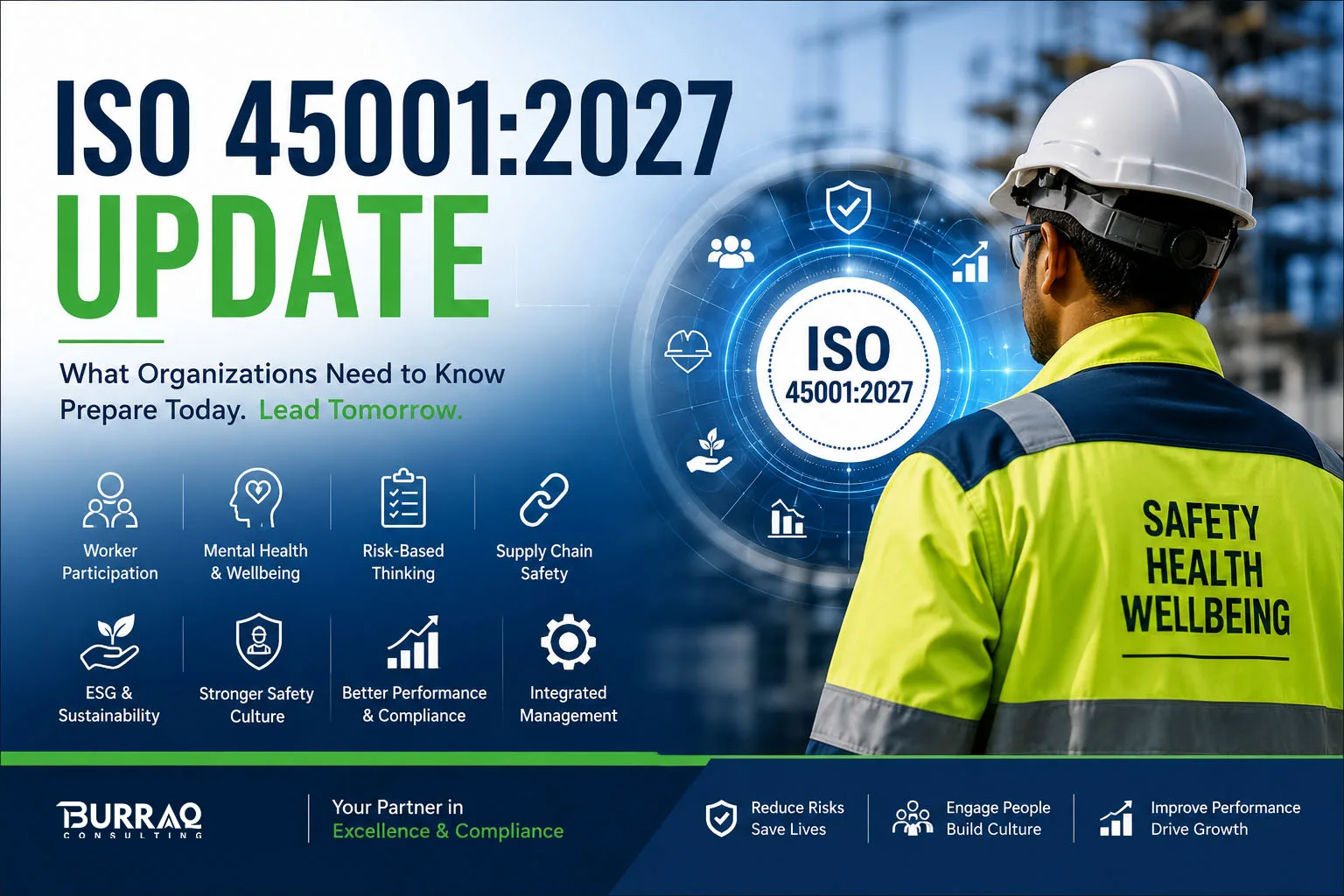
ISO 45001:2027 Update - Key Changes & Transition Guidance
Workplace safety is no longer limited to compliance checklists and accident reporting. Organizations are now expected to create safer, healthier, and psychologically supportive work environments while managing complex operational risks. This is why the upcoming update to ISO 45001 is attracting global attention.
The expected ISO 45001:2027 update is anticipated to bring refinements that align occupational health and safety management systems with modern workplace realities, evolving legal expectations, ESG goals, supply chain accountability, remote work practices, and stronger employee participation.
For companies already certified to ISO 45001:2018, the upcoming revision will likely require careful planning, system reviews, documentation updates, and internal awareness training. Organizations that prepare early will face smoother transitions and stronger operational performance.
At Burraq Consulting, we are closely monitoring the development of the ISO 45001 revision to help businesses in Pakistan and the Middle East prepare before the transition period officially begins.
What is ISO 45001?
ISO 45001 is the international standard for Occupational Health and Safety Management Systems (OHSMS). It provides a structured framework for identifying workplace hazards, reducing risks, improving employee safety, and creating safer working environments.
The standard applies to organizations of all sizes and industries, including:
- Construction companies
- Manufacturing industries
- Oil & gas organizations
- Logistics and transportation companies
- Hospitals and healthcare facilities
- Educational institutions
- Engineering firms
- Warehouses and distribution centers
- Service sector organizations
ISO 45001 helps organizations move from reactive safety management toward proactive risk prevention.
Why is ISO 45001 Being Updated?
International standards are periodically reviewed to ensure they remain relevant and aligned with global business practices. Since the release of ISO 45001:2018, workplaces have undergone major changes, including:
- Increased remote and hybrid working
- Greater focus on mental health and wellbeing
- Rising ESG and sustainability requirements
- Supply chain safety expectations
- Stronger worker consultation requirements
- Digital transformation in workplace monitoring
- Emerging occupational risks from automation and AI
The ISO committee responsible for occupational health and safety standards is expected to introduce updates that improve clarity, consistency, and integration with other ISO management system standards.
Expected Changes in ISO 45001:2027
Although the final published version may differ, industry experts anticipate several important enhancements in the upcoming revision.
Stronger Focus on Mental Health & Psychological Safety
One of the most anticipated changes is a greater emphasis on psychosocial risks. Organizations may need to address issues such as:
- Workplace stress
- Burnout
- Harassment and bullying
- Fatigue management
- Mental wellbeing
- Work-life balance
- Psychological hazards
This reflects growing recognition that occupational health includes both physical and mental wellbeing. Companies will likely need more structured approaches to identify, assess, and mitigate psychosocial risks.
Enhanced Worker Participation and Consultation
The revised standard is expected to reinforce employee involvement in health and safety decision-making. Organizations may need to demonstrate:
- Active worker consultation
- Participation in risk assessments
- Reporting mechanisms for unsafe conditions
- Transparent communication systems
- Employee engagement in incident investigations
This approach improves safety culture and increases accountability throughout the organization.
Better Integration with ESG and Sustainability Goals
Environmental, Social, and Governance (ESG) reporting is becoming increasingly important worldwide. The ISO 45001:2027 update may align more closely with sustainability frameworks by connecting workplace safety performance with broader corporate responsibility objectives.
Organizations could be expected to measure and report:
- Safety performance indicators
- Worker wellbeing initiatives
- Contractor safety performance
- Occupational illness trends
- Social responsibility commitments
This is particularly relevant for multinational organizations and exporters working with international clients.
Improved Supply Chain and Contractor Safety Controls
Many workplace incidents occur through outsourced operations and contractor activities. The revised standard may place stronger requirements on:
- Contractor evaluation
- Supplier safety monitoring
- Third-party compliance
- Site access controls
- Shared workplace responsibilities
Organizations will likely need more documented evidence showing how external parties are controlled under the OHS management system.
Greater Emphasis on Risk-Based Thinking
Risk-based thinking already exists within ISO 45001:2018, but the new version may strengthen requirements for proactive hazard identification and predictive safety management.
Expected areas of improvement include:
- Near-miss analysis
- Preventive action systems
- Emerging risk identification
- Technology-related hazards
- Human behavior considerations
- Data-driven safety decisions
Organizations may need more advanced monitoring and reporting mechanisms.
Alignment with Other ISO Standards
ISO standards are increasingly designed for easier integration.
The ISO 45001:2027 revision is expected to improve compatibility with:
- ISO 9001
- ISO 14001
- ISO 27001
This will support organizations implementing Integrated Management Systems (IMS).
Potential Impact on Certified Organizations
Organizations already certified to ISO 45001:2018 should prepare for a transition period once the updated standard is officially released. The impact may include:
Documentation Updates
Existing procedures, policies, and risk assessment methods may require revision to align with new clauses and terminology.
Internal Auditor Training
Internal auditors will need updated competency training to understand revised requirements.
Risk Assessment Revisions
Organizations may need to incorporate psychosocial hazards and emerging operational risks into existing assessments.
Leadership Involvement
Top management responsibilities may expand further regarding worker wellbeing and organizational culture.
Certification Transition Audits
Certification bodies will likely conduct transition audits before organizations can migrate to the updated version.
Industries That Will Be Most Affected
Some sectors may experience greater operational impact from the ISO 45001:2027 update.
Construction Industry
Construction companies may face stricter contractor management and worker participation requirements.
Manufacturing Sector
Manufacturers may need stronger controls for automation-related hazards and machine safety integration.
Oil and Gas Industry
High-risk industries will likely see increased focus on behavioral safety and risk-based monitoring.
Healthcare Sector
Hospitals and clinics may need improved systems for psychological safety and workplace stress management.
Logistics and Transportation
Fatigue management and worker wellbeing could become more prominent in transport operations.
ISO 45001:2027 and Integrated Management Systems
Many organizations are now combining multiple ISO standards into one unified management system. The updated ISO 45001 standard will likely support smoother integration with:
- Quality Management Systems
- Environmental Management Systems
- Information Security Management Systems
- Energy Management Systems
Integrated systems reduce duplication, improve efficiency, and simplify audits.
How Burraq Consulting Can Help?
Burraq Consulting provides professional consultancy, implementation, training, auditing, and certification support for occupational health and safety management systems across Pakistan and the Middle East.
Our services include:
- ISO 45001 implementation consultancy
- Gap assessments
- Internal auditor training
- Documentation development
- Risk assessment support
- Integrated Management System consultancy
- Certification audit preparation
- Transition support for updated ISO standards
Our consultants work closely with organizations to create practical systems that improve compliance, operational control, and workplace safety performance.
Final Thoughts
The upcoming ISO 45001:2027 update is expected to strengthen how organizations manage occupational health and safety in increasingly complex working environments. While the core structure of the standard will likely remain familiar, organizations should expect greater attention toward mental health, worker participation, contractor control, ESG alignment, and proactive risk management.
Businesses that start preparing early will be better positioned to transition smoothly, improve safety culture, and maintain compliance with evolving international expectations. Organizations waiting until the last moment may face rushed implementations, audit pressures, and operational inefficiencies.
For expert guidance on ISO 45001 implementation, transition planning, training, and certification support, connect with Burraq Consulting today.