
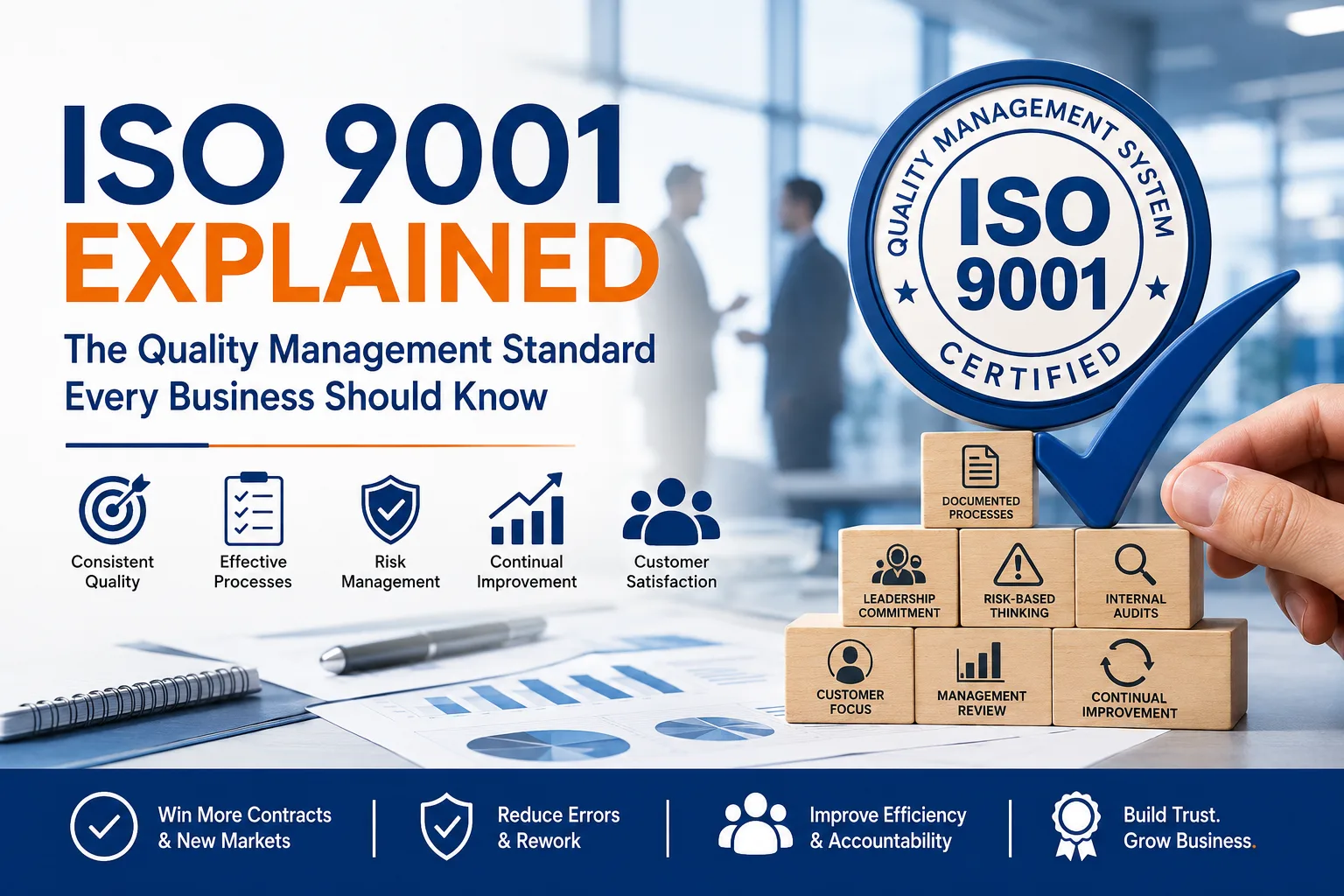
ISO 9001 Explained The Quality Management Standard Every Business Should Know
If you’ve spent any time around procurement teams, tender documents, or corporate clients in Pakistan, you’ve probably run into the phrase “ISO 9001 certified” more than once. It shows up on company profiles, on the back of business cards, sometimes even framed on office walls. But ask most business owners what it actually means, and you’ll get a vague answer about “quality” and not much else.
That’s a problem, because ISO 9001 isn’t a trophy. It’s a working system, and understanding what it actually does can change how you think about running your business — not just how you market it.
So What Is ISO 9001, Really?
ISO 9001 is an international standard for Quality Management Systems, or QMS. It was created by the International Organization for Standardization, and it lays out a framework for how a company should manage its processes so that the end result — a product, a service, whatever you deliver — meets a consistent standard every single time.
Notice what that definition doesn’t say. It doesn’t say your product has to be the best in the market. It doesn’t grade your output against competitors. What it certifies is consistency: that you have a system in place, that people follow it, and that the system gets checked and improved over time.
Think about a restaurant that makes an incredible dish once, but can’t reproduce it the same way twice. That’s a talent problem, not a quality management problem. ISO 9001 is about building the kind of business where the tenth customer gets the same experience as the hundredth, and the thousandth.
Who Actually Needs This
Here’s where a lot of business owners get stuck — they assume ISO 9001 is only for large manufacturers or export-heavy companies. That’s outdated thinking.
Any business that delivers a repeatable product or service can benefit, including:
- Manufacturers who need to reduce defects and rework
- Service companies bidding on corporate or government contracts
- Construction and engineering firms managing multiple projects at once
- IT and software companies delivering client work at scale
- SMEs looking to work with multinational clients who require certified vendors
If your business has grown past the point where the owner personally checks every piece of work before it goes out the door, you’re probably at the stage where ISO 9001 starts paying for itself.
There’s also a market reality worth naming directly. In sectors like energy, textile, cement, and pharmaceuticals, many large buyers simply won’t shortlist a vendor without ISO 9001 in place. It’s become a baseline requirement rather than a differentiator in some tenders — which means not having it can quietly cost you deals you never even hear about.
What the Standard Actually Requires
ISO 9001 is built around a handful of core ideas, and none of them are as intimidating as the paperwork reputation suggests.
Process documentation. You need to define how your key processes actually work — not in theory, but as they’re really done. This becomes the reference point for training, consistency, and troubleshooting when something goes wrong.
Customer focus. The standard requires you to actively track customer requirements and satisfaction, not just assume you know what clients want.
Risk-based thinking. Rather than waiting for problems to happen, you’re expected to identify where things could go wrong and plan around it. This is one of the more useful parts of the standard, honestly — it forces a level of forward planning that a lot of growing businesses skip.
Management review. Leadership has to regularly review how the QMS is performing, not delegate it entirely and forget about it. Ownership matters here.
Internal audits. Before an external body ever certifies you, your own team has to periodically check whether the system is actually being followed, not just written down somewhere and ignored.
Continual improvement. ISO 9001 isn’t a one-time achievement. The standard expects your quality system to evolve as your business does.
None of this demands a massive bureaucracy. Small companies can run a lean version of this system just as effectively as a 500-person manufacturer — the principles scale down fine, even if the paperwork volume doesn’t need to.
The Certification Process, Briefly
Getting certified generally follows a familiar path: a gap analysis to see where your current processes stand against the standard, documentation and process development to close those gaps, staff training so people actually understand and follow the new system, an internal audit to catch issues before the real one, and finally a two-stage external audit by a certification body — first a documentation review, then an on-site assessment of whether you’re actually doing what you say you’re doing.
Most SMEs can move through this process in a few months if they commit to it properly. Companies that treat it as a document-writing exercise rather than an operational change tend to take longer, and often struggle to keep the certification once they have it.
Why It's Worth the Effort
The certificate itself opens doors — tenders, new markets, partnerships with companies that require certified vendors. That part is obvious and often the reason businesses pursue it in the first place.
But the more lasting value tends to show up internally. Companies that go through the process properly usually end up with fewer errors slipping through, clearer accountability when something does go wrong, and new employees who ramp up faster because the “how we do things” knowledge lives in a documented system instead of only in a few senior people’s heads.
There’s also a quieter benefit worth mentioning: it changes how disputes get resolved. When something goes wrong with a client, having a documented process to point to — rather than a “he said, she said” situation — tends to protect both the relationship and the business.
Common Mistakes Worth Avoiding
A few patterns show up again and again with companies going through this process for the first time.
Some treat it purely as a paperwork exercise, writing documents that describe an idealized version of their operations rather than what actually happens on the floor. Auditors notice this quickly, and it undermines the whole point of the system.
Others get certified and then let the system quietly die — no internal audits, no management reviews, nothing updated as the business changes. The certificate stays on the wall, but the system behind it stops functioning. This is usually what causes companies to lose certification at renewal time, and it’s entirely avoidable with a bit of ongoing discipline.
And some businesses underestimate how much buy-in matters. If staff see the QMS as something imposed from outside rather than a tool that actually makes their work easier, adoption stays shallow, and the whole exercise becomes a compliance headache rather than a genuine improvement.
Where to Start
If you’re weighing whether ISO 9001 makes sense for your business, the honest answer is: it depends on where you’re trying to go. If you’re chasing larger contracts, working toward export markets, or simply tired of quality issues that seem to repeat themselves no matter how many times you address them individually, it’s worth a serious look.
A proper gap analysis is the right first step — it tells you exactly how far your current processes are from the standard, and what it would actually take to close that distance. That’s a far more useful starting point than guessing, and it’s usually the difference between a certification process that goes smoothly and one that drags on for a year longer than it needed to.
How Burraq Consulting Can Help?
This is exactly the kind of process Burraq Consulting works through with clients every day. From the initial gap analysis to documentation, staff training, internal audits, and getting you ready for the external assessment, our team walks alongside your business rather than handing you a folder of templates and disappearing.
We’ve worked with companies across energy, cement, textile, pharmaceutical, and manufacturing sectors, so we understand that a QMS built for a 20-person workshop looks nothing like one built for a large industrial plant — and we build accordingly, not off a one-size-fits-all playbook.
If you’re considering ISO 9001 certification and want a clear, honest picture of what it would take for your business, get in touch with Burraq Consulting for a consultation. We’ll help you figure out where you stand and what the path forward actually looks like.